Basement floor epoxy coating in Fayetteville, AR is a straightforward upgrade when the slab is in good shape — and a more involved project when it isn’t. The most important step is moisture testing. Northwest Arkansas sits on clay-heavy soils that hold water after the region’s frequent spring and summer rains. That moisture moves upward through the concrete as vapor, and if a coating is applied over a slab with excessive vapor emission, the floor will blister and peel within months. We test every basement slab before we quote, and we tell you honestly what the numbers mean for your project.
Clean concrete ready for an epoxy base coat — proper surface prep is what separates a lasting floor from one that peels.
What Does Basement Floor Epoxy Involve?
The process is similar to a garage floor but with extra emphasis on moisture management. We start with a relative humidity test using probes inserted into the slab at multiple points. If the reading is under 75% RH, we proceed with a standard 100% solids epoxy system. If it’s above that threshold, a moisture-mitigation primer goes down first before any epoxy touches the slab.
Surface preparation uses a walk-behind grinder rather than acid etching. Basement concrete is often smoother than garage slabs because it was poured for interior use, which means the grinder needs to work more carefully to create the right surface profile without going so deep that it damages the slab. Cracks and control joints are filled, and the full epoxy base coat plus topcoat system goes down in the same sequence as a garage floor.
When Do Fayetteville Homeowners Need Basement Epoxy?
Most calls about basement epoxy in Fayetteville come from homeowners finishing or remodeling a basement space. Raw concrete is dusty, hard to keep clean, and looks unfinished. Coating it costs far less than flooring alternatives like luxury vinyl or tile while producing a seamless, washable surface that handles moisture better than wood-based products ever will in an NWA basement.
The other common trigger is an existing coating that’s failing. Basement coatings applied without proper moisture testing are a frequent problem, and the symptoms — bubbling, peeling patches, white haze on the surface — usually show up within the first year. A proper recoat starts with stripping the old material, testing the slab, and applying a system rated for the actual moisture conditions.
Why Does Basement Coating Fail in NWA?
Arkansas averages around 49 inches of rainfall per year, most of it concentrated between March and June. After a heavy spring rain, the clay soil around a Fayetteville basement foundation can hold significant water for days or weeks. That water eventually moves through the slab as vapor. If a contractor coats over a wet or borderline slab without testing — which happens frequently with big-box kit installations — the moisture pressure builds under the coating until it separates from the concrete.
The other common failure cause is applying a water-based epoxy in a basement that already has ambient humidity above 85%. The coating cures incorrectly and develops a white haze called “amine blush,” which weakens the bond and creates a surface that feels tacky rather than hard. We track weather conditions and won’t install coatings during days when basement humidity makes a clean cure impossible.
What Affects the Cost of Basement Epoxy in Fayetteville?
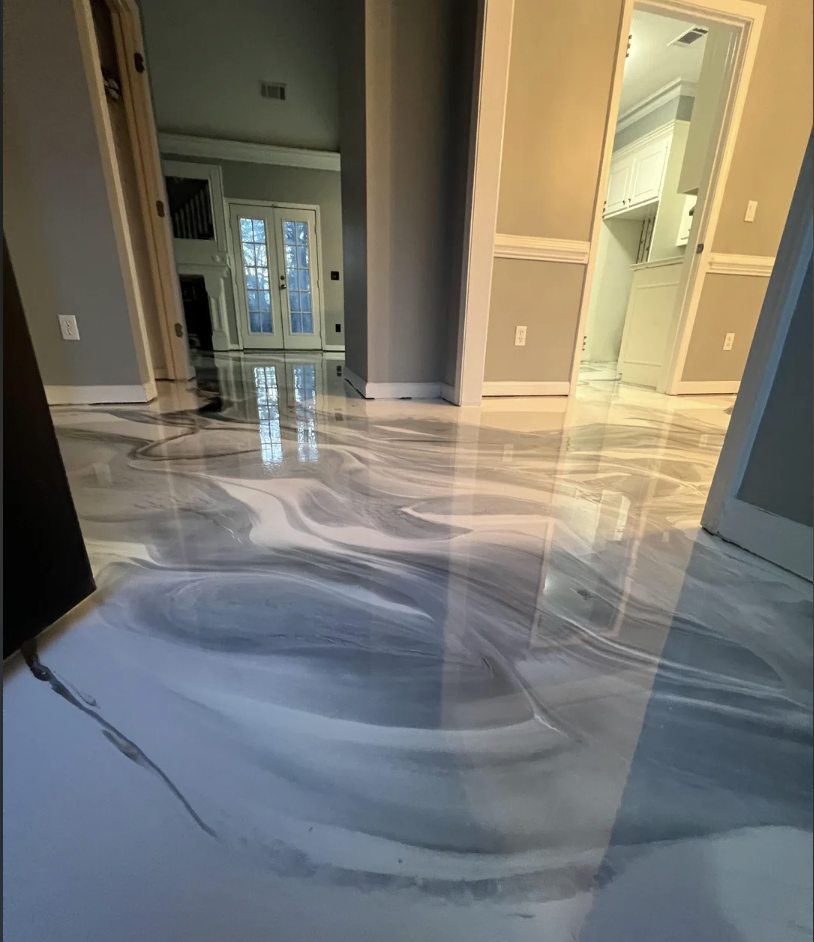
Square footage drives most of the cost. A 500 square foot unfinished basement typically runs $2,200 to $3,500 for a full epoxy and polyaspartic system. Larger basements of 800 to 1,000 square feet come in at $3,500 to $5,500. Moisture remediation, when required, adds $1.50 to $3.00 per square foot. Decorative options like metallic epoxy or high-density chip systems cost more than standard flake finishes. We find moisture remediation is needed on roughly 20% of Fayetteville basement slabs we evaluate.
Epoxy vs. Painted Concrete: Which Is Right for Your Fayetteville Basement?
Concrete paint and epoxy coating are not the same product. Paint is a thin film that sits on the surface; epoxy penetrates and chemically bonds to the concrete before hardening into a coating 10 to 20 times thicker than paint. Paint in a basement typically fails within 2 to 3 years because it can’t withstand moisture vapor pressure. Professional epoxy, applied with proper prep and a compatible topcoat, lasts 15 or more years. If you’re using the basement seriously — as a gym, a workshop, or finished living space — epoxy is the right call. Paint is a short-term fix at best.
Frequently Asked Questions — Basement Epoxy in Fayetteville, AR
Can you put epoxy on a basement floor in Fayetteville, AR?
Yes, but the basement slab must be tested for moisture vapor emission first. Basements in Fayetteville sit in contact with Arkansas clay soil that retains significant groundwater after rain. We measure relative humidity inside the slab before recommending a coating system. Slabs with elevated moisture readings get a moisture-mitigation primer applied before the epoxy base coat.
How much does basement floor epoxy cost in Fayetteville?
Basement floor epoxy in Fayetteville, AR typically costs $2,200 to $5,500 for a 500 to 900 square foot space. Larger spaces and those requiring moisture remediation before coating will be toward the higher end. We quote exact numbers after the free on-site estimate, which includes a moisture test.
Does epoxy make a basement less damp?
An epoxy coating seals the concrete surface and prevents the surface moisture and concrete dust that make basements feel damp. However, it does not fix active water intrusion from cracks in walls or floor-to-wall joints. If your basement has standing water after heavy rain, that needs to be addressed before any floor coating is applied.
What is the best epoxy for an Arkansas basement floor?
For most Fayetteville basements, a 100% solids epoxy base coat with a polyaspartic clear topcoat provides the best combination of moisture resistance, durability, and brightness. Basements with very high moisture vapor readings may need a polyurea moisture-mitigation primer applied first. We select the system based on your slab’s test results, not a one-size answer.
How long does a basement epoxy floor last in NWA?
A properly installed basement epoxy floor in Fayetteville, AR typically lasts 15 to 20 years in a lightly trafficked finished basement. Home gyms with heavy equipment and rolling loads may see more wear and last closer to 10 to 12 years before needing a topcoat refresh. The critical variable is whether the moisture was properly addressed before installation.